Mad in Pursuit Notebook

The Bigamist: Samuel Newham Sr.
The complications of immigration
Sometimes history provides many interesting facts. What it doesn't reveal are the emotions and motivations swirling around those facts. Such is the case with our third-great-grandfather.
Northamptonshire, England, 1825. It is likely some time in March that 21-year-old Charlotte Miller told Samuel Newham that she was pregnant. They hurry up and have a Church of England wedding on 8 April. On 12 October, their daughter Jane was born. Sam was 27. Like his father and two older brothers, he was a wheelwright, a highly specialized woodworker who made and repaired the wheels that keep wagons and carriages rolling.
Family man. About 18 months after Jane, their son Edward was born, named after Sam's recently deceased father. Another 18 months—daughter Mary Ann was born. Within a couple of months, Charlotte found herself pregnant again.
This was a turning point. Sam's gaze turned toward America and its promise of prosperity. His older brother John was liquidating their father's business, but (according to the will) he had inherited it all, with the only provision being to support their mother.
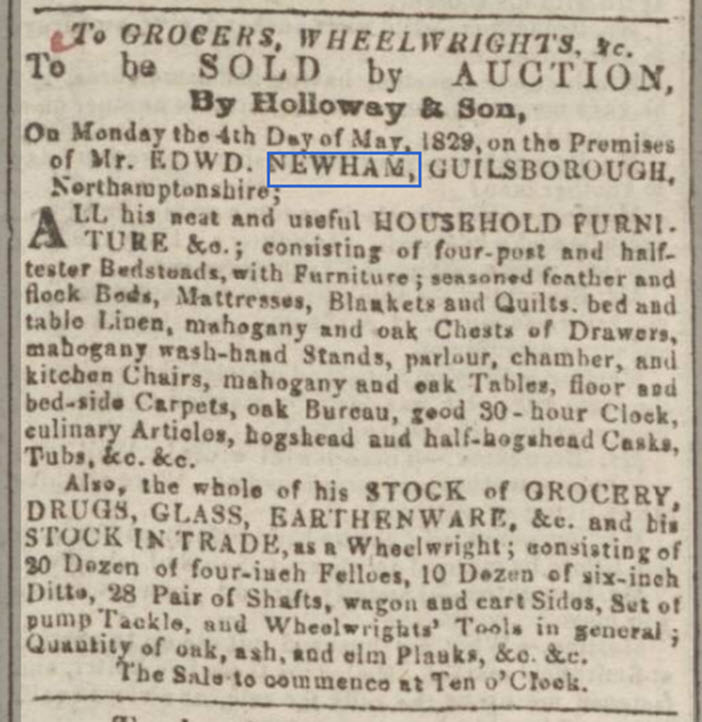
Was Sam bitter at being left out of his father's will, willing to risk everything to seek his fortune in the New World? Or, understanding Sam's need for opportunity, did John generously stake his brother's passage to New York?
What was Sam's promise? With three babies and another on the way, did Sam plan to find work and housing in America, then send for his family? Or to return with money in his pocket? Was Charlotte okay with this—content to stay near her family and not disrupt her children while her husband pioneered their future?
New Jersey. However it came about, 32-year-old Sam boarded the Royal Mail Packet Steamer St. George and landed in New York on 6 April 1830, two weeks before his son Samuel (Jr.) was born. [1] [2]

Sam Sr. quickly established himself as a wheelwright in Jersey City, which was a lively transportation hub across the Hudson River from Manhattan.

One, two, three years passed with no sign of Charlotte and the children. What happened?
What we know for sure is that on 24 November 1835, Sam Sr. married 39-year-old Mary Kingsland, with the blessing of the Reformed Dutch Church of Bergen NJ.
Had he fallen in love with this American woman and abandoned his wife and family? If the premarital pregnancy led to a loveless marriage, divorce was not an option for commoners in England. This opens the possibility that he simply fled from his responsibilities to America.
On the other hand, maybe he sent for Charlotte and she refused to come. She felt kindly enough toward Sam Sr. to name their last child after him. But it was a tough decision for a mother of four to leave her own family and familiar surroundings for the unknowns of a new nation. The promise of wealth was a visionary's dream, not hers.
Who knows if Sam Sr. sent money to Charlotte. The only reflection of his affections was found in his 1848 will. His estate supported his new wife till her death, then went to his children. No mention of Charlotte.
Sadly, there was a cost to the estrangement. On 2 May 1838, their 10-year-old son Edward died. His death registration states the cause as "inflammation on the brain," which was probably meningitis. It also mentions that his father had gone to America.Was there correspondence between Middleton and Jersey City? Did Charlotte write? No doubt it left her questioning everything.

As Sam Sr. continued to build his business, his 16-year-old nephew Charles (already a skilled wheelwright) also caught the bug to make his fortune in America. His ship landed in Boston in 1842. He stayed there three years before joining his uncle in Jersey City. If Sam Sr. hadn't known about the death of Edward by then, Charles would have told him.
In 1846, the Newham family having established a foothold in Jersey City, Sam's older brother (and Charles's father) decided to follow. Edward (age 55, a wheelwright) and his wife Hannah had a big family to move: Mary (20), Catherine (18), Thomas (16), Septimus (12), Elizabeth (10), and Louisa (6). The family's reunion with Sam Sr. and son Charles was tragically overshadowed by the death of their daughter Mary at sea [3]. It was a heavy burden for her father Edward, who died within two years.
On 6 Jul 1849, at age 51, Sam Sr. died of heart disease. While on his deathbed, he wrote his will, appointing his nephew Charles as one of two executors. This is the document that acknowledges his three surviving children and grants them the proceeds of his estate after the death of his second wife Mary. His estate consisted of his residence, his wheelwright shop, and a rental property near the railroad and harbor of Jersey City.
They didn't have long to wait. Within nine months of their father's death, Mary Kingsland Newham also died.
Did Charles Newham properly discharge his duties and send the three offspring their inheritance? We may never know. My great-great-grandfather Sam Jr. was just turning 20. All we know is that at age 24, he marries Frances Bennett and they move away to the village of Witham-on-Hill in Lincolnshire, where he sets up shop as a master tailor. We may never find out if his father's money helped.
Finding out what happened to Sam Sr. was a mystical experience in itself. Read more about that here>>>
Notes
Citations and documents underlying this story are available on my family tree at Ancestry. If you'd like to know more, contact me.
[1] I will refer to father and son as Sam Sr. and Sam Jr. from here on.
[2] The St. George was wrecked in November of 1830.
[3] The Newhams settling in New Jersey gave our great-grandmother Sarah Newham Price many second cousins in that area. I wonder why she and WJ Price decided not to join family there when they emigrated to the States. Were they in touch? Was there some shame connected to the fact that her grandfather had a second wife and a separate life there?
[4] 1841 census information.
20 Dec. 2025

All pages in this website by Susan Barrett Price are licensed under a Creative Commons Attribution-Noncommercial-Share Alike 3.0 United States License.